I was asked to be a traveling DM: visit friends further out from my place to run them a game of D&D. The players are new to tabletop roleplaying, with one of them having visited one of my Mountain Witch games prior, and the other brand new to the hobby. I did get to bring my wife along to have a more experience player in the mix.
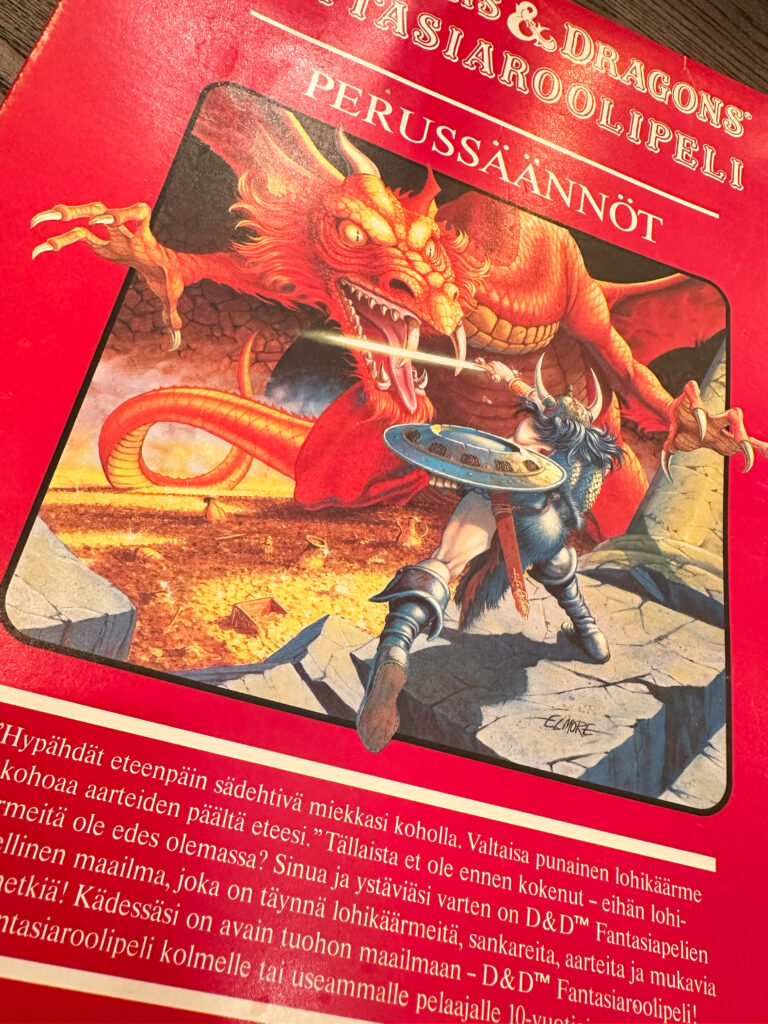
My initial thinking was that I’d come up with a reasonably intricate one shot with complex, compelling characters, albeit streamlining their in-game options quite a bit with custom character sheets to not overwhelm the new players. I started working on this, but then I stumbled on the cover art for D&D red box from the 80s. That image of a lone fighter charging a dragon guarding its treasure hoard was what pulled me into the game in the first place. Why shouldn’t it work today?
Initial thoughts
I went back to how most people learn to play D&D: an introductory dungeon. I searched online for a popular introductory dungeon, and landed on Most Potent Brew by Richard Jansen-Parkes. Seems very simple, with just enough elements, and very little danger of sprawling beyond the intended scope. It has glowing reviews. So it isn’t a dragon, you’re actually facing giant rats, but it does deliver on what people – I believe – expect from low level D&D. My thinking is that there’s a reason people go back to these, and then get bit by the TTRPG bug. Of course that doesn’t work for everyone, but these players are curious about specifically D&D, so that’s what they should get.
So what’s in a “vanilla” D&D experience? All the themes of the game should be present: exploration, roleplaying, and fighting. Getting a quest to go to a small dungeon should tick all of these boxes. What we can’t really do in a single session is character progression, but I’m thinking of giving some of that flavor by gating a part of the character abilities and unlock them for a second encounter.
I’m going to make streamlined character sheets and bring miniatures and the nicest dice I have for maximum impact. Well, that’s what I thought!
Let’s revisit this
Preparing for the game, I finally read through the 2024 Player’s Handbook, and it dawned on me that character creation really is the whole point of D&D. That’s all the book is – endless lists of feats, powers, and spells. Most character classes come with their own mechanics. Creating your character and building it over time is the game. Thus: I can’t skip that.
I revised the plan to be a remote session where we create characters and set some context, and then a single session adventure on-site.
How did it go
We created characters using D&D Beyond on mobile devices. This was quite the challenge, and in retrospect I think we might’ve been better off just going by the book. I wouldn’t do this with brand new players again – they miss out on the art and get quite lost in the options on the app.
I designed a simple adventure using the Dungeon Master’s Guide’s (very limited) random adventure generation tables as a starting point. I wanted to have light roleplaying, some exploration, and at least two combats. I didn’t want to force the players to solve the problem they’re facing with violence, even if I found that a likely outcome. Finally, I stopped to consider what are uniquely D&D things, and made sure we had some of that. For me, that meant weird fantasy races and classes, and interacting with them.
The characters were a Wizard, a Ranger, and a Bard (my wife – the more experienced player from my standard group) – a fine group for any sort of low level antics!
You meet at an inn
The adventure had the characters meet in a small town’s only inn, run by a retired cloud heritage goliath sorcerer, who couldn’t leave her inn. (The players didn’t discover it, but her now abandoned otherworldly patron was locked up in the basement, and she couldn’t risk releasing it.) I introduced atmospheric and spooky details to the place, had the players describe how they’ve all arrived to this place, and establish a bit of relationship between each other.
Then the innkeep asks them to help with a situation: she’s managed to anger a group of sorcerers, having thrown them out when they couldn’t pay their bill, and now the undead are plaguing the town’s borders. The heroes set out to clear the undead and put a stop to the sorcerers.
I structured the search for the undead and the sorcerers as skill challenges, which are a mechanic I cherish from D&D 4E and use in all of my games these days. This allowed the players to explore their characters’ out of combat abilities and find ways to express themselves.
They encountered a series of seriously underpowered monsters – lone undead, stirge, and twig blights – to give them a feeling of how combat works and what their characters are capable of. This felt like a great approach that I’d replicate in a similar situation. Just the thought of a threat to their characters was enough to set the players on edge initially: no need for a real mechanic/mathematical threat.
Having cleared the town perimeter of threats, they made after the sorcerers. They were holed up in a forgotten graveyard. I gave the players the barest of a hint (I described a dwarf’s emo haircut!) that perhaps they don’t need to attack, and they took another approach. They talked to the “sorcerers” (misled teenagers, more like) and sent them away, leaving only their leader, an older orc, who I also portrayed as an outcast nerd, led astray by a vile book with a malign spirit within. I meant them to be able to handle the boss sorcerer with roleplay or trickery, too, perhaps opting to destroy the book, but they ended up fighting the orc. This was the only “balanced” fight in the game, and it worked really well – the players had to push, and even resort to death saves.
While I couldn’t plan for it, the dice gods favored the new players and gave them multiple well timed critical hits to feel great about and celebrate!
What happens next?
As the closing, the players wanted to sanctify the old temple the sorcerers had been using for evil spirit worship. I asked for a religion roll, and what do you know: a natural 1, the first in the game. An ill wind from beyond arose, carrying the cries of the damned, and as the graveyard started to tremble, we cut to black. Everyone was left engaged and excited about what could happen next!
As introductions to D&D go, I don’t think this could’ve been much better, even if I had zero dungeons or dragons even hinted at. If I do this again, I’m going to use the exact same approach, and just build in a little more atmospheric and immersive detail.
The character creation does still leave me thinking. It’s a lot of effort and frontloading to get to make those juicy character building choices. Perhaps it would be better served by preparing a choose your own adventurer type approach, which of course would be a lot more work for me.
This experience salvaged my life long love for D&D to a degree. Thank you, curious, new players, for your interest and faith!


Leave a Reply