I am working on a game design with a friend. We’ve played a number of what I’d call conventional tabletop roleplaying games with romance and sex in them, ranging from Thirsty Sword Lesbians and Monsterhearts to Bad Sex and Star Crossed. I’m interested in further exploring intimacy as a game design element and a table experience.
We listened to Dice Exploder’s series on romance and sex in roleplaying games and were inspired (among other things) by its discussion on bringing physical touch to the table. What if we lifted some of the techniques we were intrigued by and brought them together in a single game, designed to build intimacy in-game?
This post is about where we started from, and our first steps in playtesting. After pair and group tests, we are now confident to keep developing the game.

Pretend reality TV
We landed on a romance reality TV theme for the game. This gives a number of useful elements:
- The participants start the show by not knowing each other, yet with the expectation of building intimacy with them. The players are in an identical position – while they might know each other as people, the characters are brand new.
- The show provides a ritualistic framework for the game. I’ve found rituals to be very powerful at the roleplaying game table, and want to explore that more. A given show always proceeds in the same fashion, and we’ll replicate that in the game.
- Romance reality shows usually have well designed sets used in specific interactions. We’d like to take this and bring it to the physical space, setting aside ritual spots in the playing space for specific interactions like character introductions and dates.
- A show has an audience. We’re roleplaying the increasing intimacy in front of the other players, arranged as a literal audience.
Let me touch you
Physical touch in tabletop games isn’t really explored, at least not in the games I’ve come across, even when the games are about romance (Star Crossed, Breaking The Ice) – interestingly in this context, Bad Sex, which is all about make believe, graphic physical intimacy, explicitly tells you not to act out any of the fiction at the table (I would say for good reason, mind). LARPs have plenty of this, but neither of us is interested in LARPing a season of Temptation Island, Love Is Blind, or Too Hot To Handle.
Tabletop games allow us to condense and edit things, as well as better calibrate the level of intensity. We’re seeing if that could be combined with elements from LARP allowing for deeper immersion thanks to the physical element of embodying the characters, in a fun way!
The game’s early focus is in building intimacy through simple physical techniques that escalate across a series of dates as the characters are trying to both learn more about the other person, and open up about their own secrets, getting someone to listen to their story, to see them.
In the game, intimacy is put on a scale. This intensity starts at sitting too close to each other and builds up to touching arms (simulating sex), slow dancing, and feeding each other. There’s also hugging (for too long), and touching fingers, shoulders, knees, feet, cheeks, and hair, and non-touch intimacy like staring into each other’s eyes (for too long), and whispering close to the other person’s ear. Some of these are treated as romantic intimacy, some as hot. The players get to choose if they’re after romantic or hot intimacy, or any at all.
Everything is opt-in, with one player initiating the intimacy by asking for permission verbally, and the other player having the space to decide how they feel about it, and if they want to accept, or indeed reciprocate. Everything is choreographed in a way that makes it clear what’s going to happen (“Can I touch your hair?”), while leaving room for personal expression and emotion: how you actually go about it, and for how long. You end all interaction by saying “thank you”, which can come from either participant.
The escalating intimacy happens in the framework of getting to know your dates, and discovering people who are willing to learn about your true self. This is done with a selection of “revelations”; your personal issues (“low self esteem”, “mommy issues”, “fear of being alone”, “cheater”, “cheated”) on a set of cards that you’re looking to give away to someone who really sees you. You choose your issues in the beginning, and hope to find someone who gets to know the real you, while exploring increasing intimacy with them.
Why do all this?
To answer the obvious question: we’re not doing this to build things all the way up to players having real world sex with each other, escalating the intensity of touching each other, step by step. I realize that’s a thing that might happen as people let their guard down with people who are, presumably, already quite close to each other to be interested in playing this game in the first place.
The techniques have been designed with de-escalation in mind, always returning to an established, safe baseline before anything else can happen, allowing us to explore touch and emotion without crossing a line. You touch their shoulder for a moment, they say thank you, and you both lean back without touching, before proceeding anywhere else. Still, before we play, we need to acknowledge that real attraction to the other players is a possible outcome, and something we’re willing to deal with, should it happen.
That’s not the goal here, though: we’re interested in the space of intimacy around the game and between the players and characters, and emotional bleed – how player and character emotions mix and interact – sometimes in unique ways, such as a player sitting in for the audience of a date where their romantic interest is with someone else, while feeling rejection and jealousy as their character, quite possibly also rejection and envy as the player, while participating in the game as a non-character, an audience member who is there just to observe the date the other players are on.
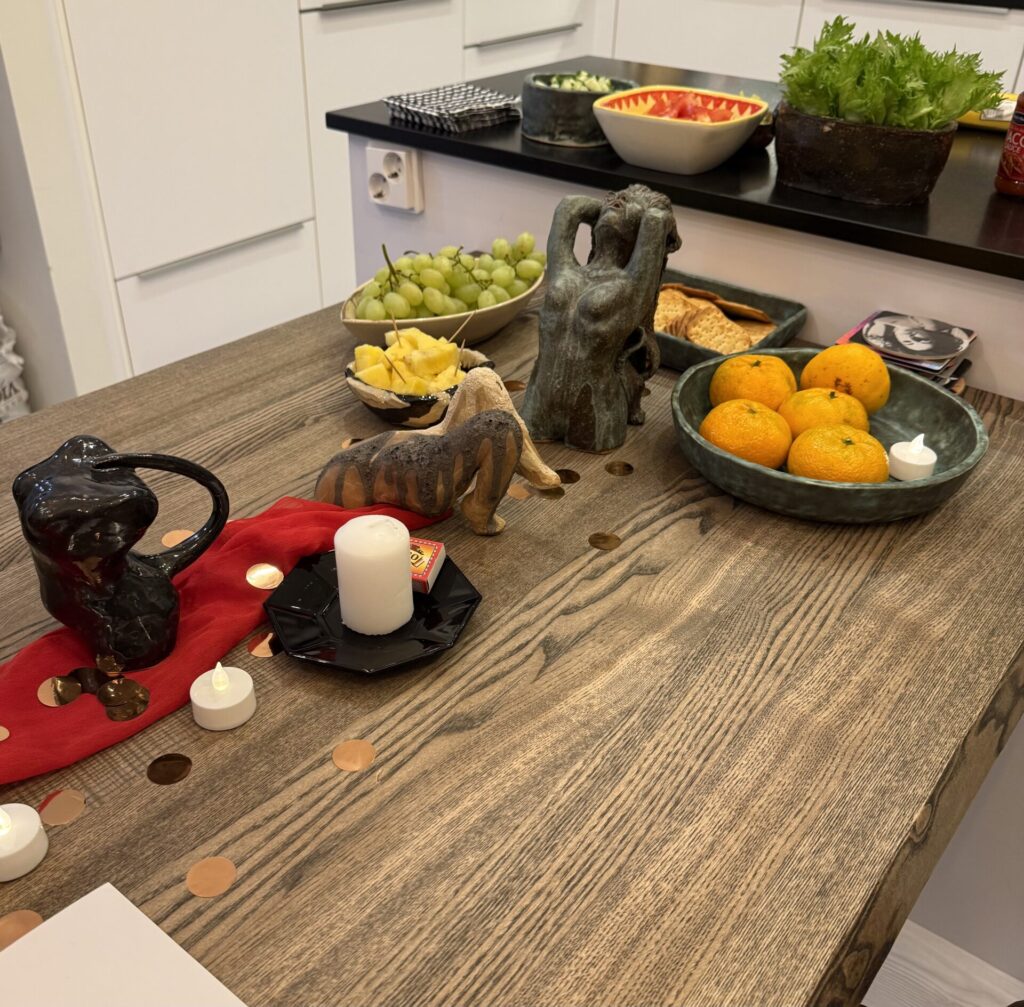
In testing, we’ve found it fascinating how players shift between their real selves and the characters they’re portraying, and how that affects the physical experience, even sensations like taste and touch, and of course the emotions they’re projecting on the characters, and the emotions they’re feeling as their real selves. Sitting on the sofa, feeding fruit to each other, is a lot easier when immersed in your character who’s on a romantic date in a TV show, than when you realize you’re touching the lips of a friend you’re not normally this intimate with. It’s interesting, a type of intimacy we don’t get to explore or play with in any other context.
In our experience, players will feel substantially closer to each other after the game, and for a tabletop roleplaying game, I believe that’s a noble goal! We’re aware of the care you need to take here, and plenty of attention is spent on aligning expectations, safety during play, and aftercare. As emotions are amplified through touch, that also goes for negative emotions.
We’re not working on this because it’s easy for us, quite the opposite: this is difficult to navigate, with everyone’s (including ours) personal intimacy issues that aren’t generally talked about coming into play. But the upside is so intriguing, we want to see where this goes.
Leave a Reply